The only comprehensive illustrated history of Santa Cruz Island.
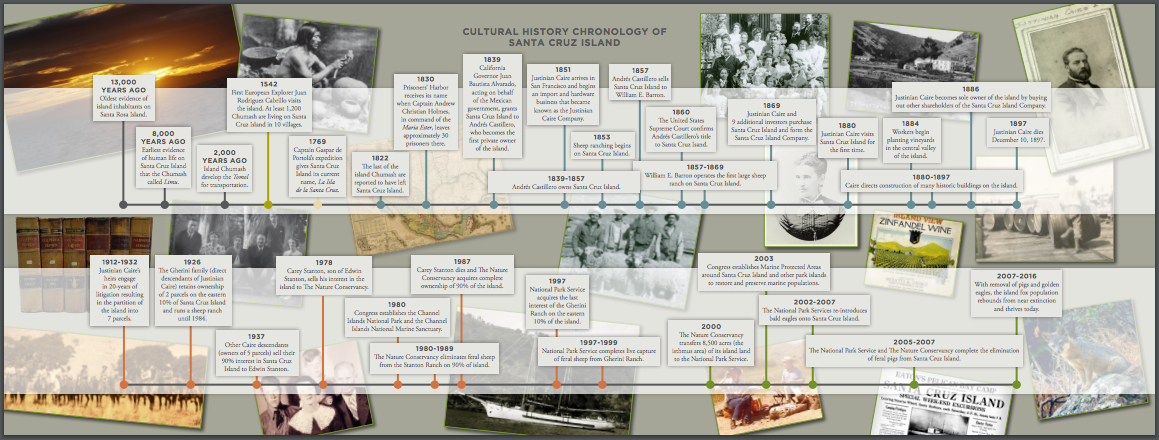
This two-volume book contains nearly 600 images, many of which have never been published. Santa Cruz Island An Illustrated History explores the geologic origins of the island and traces the cultural history from the native inhabitants, over 13,000 years ago.
The book details the ranching operation on the island, from wine production and cultivation of Zinfandel grapes to herds of sheep that roamed the island. This book also discusses the establishment of the Channel Islands National Park in 1980 and its current efforts to preserve and protect the island.
“John Gherini is the perfect individual to tell this tale. A descendant of one of the families who shaped twentieth-century Santa Cruz Island and a person with deep roots in the Santa Barbara Channel region, John brings an insider’s knowledge to this complex story.”
— Robert M. Senkewicz,
Professor of History
Santa Clara University
Santa Cruz Island An Illustrated History is available for purchase direct through this website via PayPal (see below), on Amazon, at Chaucer’s Bookstore, Tecolote Book Shop, Santa Barbara Arts & PlumGood Store.
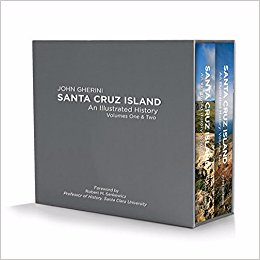
Santa Cruz Island, An Illustrated History
Buy now direct from the author, John Gherini, and SAVE! Holiday Sale. Now 40% off!
$85.00
You can also purchase Santa Cruz Island An Illustrated History on Amazon.

“John Gherini weaves natural history, cultural history, and his own family’s generations on Santa Cruz Island into a fully-realized tapestry of one of the most complex and beautiful locations among our National Parks. This is more than a splendid coffee-table book; it educates even while it illuminates.”
- James F. Brooks,
Professor of History and Anthropology,
University of California, Santa Barbara
About the Island
Rising from the waters of the Pacific off the southern California Coast, Santa Cruz Island captures the imagination. Once home to a large Chumash population, in the nineteenth century it became a self-sufficient island rancho. As with all islands of beauty and size, it attracted people from the coastline.
The attractions of the island, however, routinely led people into conflict, wrapping it in a shroud like its morning fog. The modern history of the island would witness the passion to own it, to protect it, to use it and to fight over it.
For the first time a thorough history of Santa Cruz Island‘s tumultuous past is provided. In pre-Columbian times it was a source of wealth to the indigenous peoples—the place where they made their shell bead money. During the Spanish-Mexican period it was a smuggler’s haven, where fur hunters avoided the customs officials.
As a land grant, it passed through the hands of Andres Castillero, William E. Barron, and eventually was purchased by Justinian Caire. The island flourished under the direction of Caire and his family. It was a secluded paradise off the Santa Barbara Coast, with extensive sheep and cattle holdings, as well as an esteemed winery.
Seeds of conflict were sown by Justinian Caire‘s will when the island was divided between family members. The Stantons, Rossis, Gherinis, the National Park Service and The Nature Conservancy all were involved over time. The tortured legal and family disputes are recounted for the first time in this important new work.
Island ranching, hunting and recreation, and environmental challenges are described in detail. Recent historical events involving the establishment of the Channel Islands National Park are explored, as well.
FAQ with Santa Cruz Island Author, John Gherini:
The Heritage of Santa Cruz Island
The Gherini family history is inextricably linked to Santa Cruz Island. Looking back on your years
there, is there a specific sensory memory—a view, a sound, or even the feeling of the island
air—that still serves as your “north star” when you consider why this place must be preserved?
The one sensory memory would be the island’s solitude and tranquil beauty, particularly in a dark, clear
evening under the umbrella of the Milky Way. It’s difficult to experience the same feeling in an urban
environment. While the island is only twenty-some miles distant from the mainland, it feels like you are in
another world.
Capturing a Multi-Generational Legacy
Writing a two-volume history of Santa Cruz Island is a monumental undertaking. During your
research and writing, was there a specific discovery or a family story that surprised you or
changed your understanding of the island’s legacy?
The research, over the years, was a humbling but rewarding adventure. I learned a lot about how complex and
rich the island’s history is and how intertwined it is with local, state, and national issues. As soon as some
questions get answered, more issues arise that entice one to do further research.
The Power of Partnership
The Channel Islands National Park Foundation works to bridge the gap between the park’s
immediate needs and its long-term vision. From your perspective as both a historian and a
supporter, why is a dedicated philanthropic partner such as CINPF so vital to the future of these
“Galapagos of North America”?
The public/private partnership enhances the sustainability and accountability of park lands like the Channel
Islands. This is particularly true when one considers that over 300 million people annually visit properties
owned or managed by the National Park Service. The partnership is not only beneficial, assisting with
immediate needs and long-term visions but also provides an important mechanism to share information that
is needed to facilitate good decision-making.
An Invitation to the Public
For someone who has never set foot on the islands, the experience can be transformative. How
would you describe the Channel Islands’ unique “magic” to a first-time visitor to entice them to
make the journey?
The lure of the islands reaches back thousands of years ago when early inhabitants settled on the Channel
Islands. Indeed, there is “magic” or a “magnetism” about the island. As I wrote in 1997 in my first book, Santa
Cruz Island, A History of Conflict and Diversity, “the attraction…routinely led people into conflict, wrapping it in
a shroud like its morning fog. The modern history of the island would witness the passion to own, to protect it,
to use it and to fight over it.”
In the summer of 1908, Margaret Eaton, author of Diary of a Sea Captains wife, told Captain Colis Vasquez that
she was making her first trip to Santa Cruz Island. He responded “…once you go over to those islands, you will
never be satisfied from them.” Margaret and her seafaring husband stayed on Santa Cruz Island for nearly
thirty years.
Looking Toward the Horizon
As we look at the ongoing restoration and educational efforts supported by the Foundation, what
is your greatest hope for the next generation of island stewards who will read your books and
walk the trails you know so well?
The understanding the “natural, scenic, wildlife, marine, ecological, archaeological, cultural and scientific
values of the Channel Islands” and its importance is an integral component in the Channel Islands’
preservation. It is my hope that the present and future stewards embrace the islands’ rich history and its
values. As Jean-Michel Cousteau observed “if we can learn to properly manage these rugged isles, perhaps we
can apply this knowledge toward improving resource management on a global scale.”

